
Mindfulness in Academic Journals
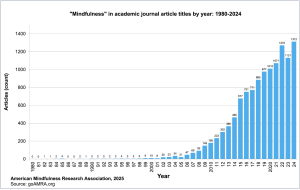 Information courtesy of the American Mindfulness Resource Association.
International Mindfulness Integrity (IMI) Network

a) A Framework for the Integrity of Mindfulness-Based Programs, Ethics and Standards, revised June 2024, A Living Document, Authored by the Transitional Working Party for the International Integrity Network of Mindfulness-Based Programs and Colleagues.
b) Article: Tending the Field of Mindfulness-Based Programs: The Development of International Integrity Guidelines for Teachers and Teacher Training, Maura Kenny, MBChB, MRCPsych, Patricial Luck, MBChB, MPhil, MSc, and Lynn Koerbel, MPH, Global Advances in Health and Medicine Vol. 9: 1-10, Sage.com/journals-permissions, 2020
Mindfulness-Based Stress Reduction vs. Escitalopram for the Treatment of Adults with Anxiety Disorders
Mindfulness-Based Stress Reduction vs. Escitalopram for the Treatment of Adults with Anxiety Disorders, A Randomized Clinical Trial, Elizabeth A. Hoge, MD, Eric Bui, MD, PhD, Mihriye Mete, PhD, et al., JAMA Psychiatry, Vol. 80, No. 1, published online November 9, 2022.
https://jamanetwork.com/journals/jamapsychiatry/fullarticle/2798510
Article:
a) Mindfulness-Based Stress Reduction Is as Effective as an Antidepressant Drug for Treating Anxiety Disorders, Georgetown University Medical Center, Featured NeurosciencePsychology, November 9, 2022
“This Loving-Kindness Meditation is a Radical Act of Love” by Jon Kabat-Zinn
Article:
This Loving-Kindness Meditation is a Radical Act of Love, Jon Kabat-Zinn, February 10, 2023
Article in Mindful includes a link to Dr. Kabat-Zinn leading a full-length audio version of the practice.
Dr. Jud Brewer shares tips for calming an anxious mind (video)
Research: Workplace Mindfulness
INCREASE EARNINGS
and
IMPROVE PERFORMANCE
by reducing employee stress
Labor organizations estimated that 30% of all work-related illness is due to stress accounting for $6.6 billion of losses in the U.S. alone!
Chronic stress has a serious impact on physical and mental health increasing risk for heart disease, some cancers, diabetes, depression, anxiety, and obesity. According to Mark Bertolini, Chairman and CEO of Aetna, where Mindfulness-Based Programs provided for thousands of Aetna employees nationwide have demonstrated
- increased productivity of more than $3,000 per person per year
- improved quality of life: reduced levels of stress and pain and improved sleep.
JOIN LEADING hospitals and health systems, U.S Marine Corps, U.S. Army, Seattle Seahawks, NBA , major corporations and businesses of all kinds in diverse settings like: Google… Aetna… General Mills… IBM… Apple… Ford… Proctor & Gamble… Eileen Fisher… and more
Research in healthcare shows that reducing stress through Mindfulness-Based Stress Reduction (MBSR) has a positive impact resulting in:
| • Improved performance | • Better decisions |
| • Reduced costs | • Improved teamwork |
| • Reduced absenteeism | • Improved communication |
| • Better customer satisfaction | • Kinder, happier workplace |
| • Healthier, more fulfilled staff | • Fewer errors, wasted time |
Research and Science of Mindfulness
According to Mindfulness Research Monthly (Black, 2010), neuroscience research on the benefits of mindfulness has become more prolific. In recent years there has been a surge in NIH-funded research trials in the U.S. In 2008, even the U.S. Department of Defense began using mindfulness practice as part of its treatment for post traumatic stress disorder (PTSD). According to Black (2010), a meta-analytic review by Sawyer, Witt and Oh in 2010 found that mindfulness-based therapies had a dramatic effect on improving both depression and anxiety.
What defines mindfulness-based programs? The warp and the weft
by R.S. Crane, J. Brewer, C. Feldman, J. Kabat-Zinn, S. Santorelli, J.M.G. Williams and W. Kyuken, Psychological Medicine (2017), 47, 990-999, Cambridge University Press 2016
Mindful Nation UK Report by the Mindfulness All-Party Parliamentary Group (MAPPG)

October 2015, Review of Scientific Evidence and Current Best Practices in Mindfulness Training, re public policy in health, education, workplace, criminal justice system.
www.themindfulnessinitiative.org.uk Video, Report, Research, January 19, 2021
Video Link: https://www.youtube.com/watch?v=xRwh-OrVQbg
Mindfulness-Based Training for Adults
Research among the scientific community has grown exponentially with researchers from leading institutions around the world leading the way. Numerous studies now show that mindfulness practice can have a profound impact on our emotional wellbeing, physical health, ability to cope with stress and challenges, relationships, and performance.
Brain scanning technologies reveal that not only does the activity of the brain change from moment to moment but the actual structure of the brain itself can change. New synaptic connections can form among brain cells and new brain cells can develop. Practice has been shown to lead to growth of key brain regions associated with emotional regulation, concentration and self-control, as well as reductions in grey-matter density, the area of the brain central to the stress response, fear and anxiety.
Mindfulness-Based Training for M-DCPS Teachers and Counselors
In the 2015-2016 school year a research study was conducted on a Professional Development Pilot Program for Miami-Dade County Public School Teachers and Administrators based on the Inner Journey ~ Mindfulness-Based Stress Reduction (IJ-MBSR) Program, the MBSR adaptation developed and taught by Valerie York-Zimmerman beginning in 2002.
As Founder of, Executive Director, and Senior Trainer for Mindful Kids Miami, from its inception through 2016, Valerie taught the 200 teachers and mental health school counselors from 100 schools who participated in the Pilot Program during the 2015-2016 school year. Miami-Dade County Public Schools (M-DCPS) is the 3rd largest and one of the most diverse districts in the U.S.
The study was a research collaboration led by Judson Brewer, M.D., Ph.D., Center for Mindfulness at University of Massachusetts School of Medicine, David J. Lee, Ph.D., University of Miami’s Department of Public Health Sciences, and Tarek Chebbi, Ed.D., Chair, Research Review Committee of MDCPS.
Study description and conclusions were included in a project supervised by Dr. David Lee in the UM – UMass REDCap System collaborative study entitled “Effectiveness of Mindfulness Training on the Well-Being of Educators.” It was a UM Medical School IRB and Miami-Dade County Public Schools approved study, which objective was to evaluate the effectiveness of mindfulness training on teachers and administrators that participated in the 8-week Inner Journey ~ Mindfulness-Based Stress Reduction (IJ-MBSR) Program training. The “Effectiveness of Mindfulness Training on the Well-Being of Educators” study was embedded in the IJ-MBSR Program as a pilot program for Miami-Dade County Public Schools Professional Development and Evaluation.
These results suggest improvements in self-compassion and mindfulness, and decreased levels of anxiety in individuals that participated in the IJ-MBSR 8 week program. These findings are consistent with previous research on the benefits of IJ-MBSR as presented in other research studies conducted below.
Other Research Studies on the IJ-MBSR Program for Adults
During the two years prior to the M-DCPS IJ-MBSR Pilot Program, research studies with adult participants in all of the Inner Journey~ Mindfulness-Based Stress Reduction (IJ-MBSR) Programs taught by Valerie York-Zimmerman were overseen and evaluated by Sharon Theroux, Ph.D., neuro-psychologist and founder of the South Florida Center for Mindfulness. Pre- and Post- Surveys which included the Five-Facet Mindfulness Questionnaire (FFMQ), Zung Anxiety Scale, and Self-Compassion Surveys were conducted.
Analysis of the data from all adult participants in the IJ-MBSR trainings resulted in significant improvements in each area: reduced anxiety, increased compassion, and improved mindfulness.
The Five-Facet Mindfulness Questionnaire (FFMQ) measures improvements associated with positive well-being something that is necessary to help reduce burnout. Higher scores in the “observing” facet are associated with good psychological adjustment. (Baer, 2008). The five facets are:
1. Observe surroundings
2. Describe thoughts and emotions
3. Act with awareness
4. Be non-judgmental
5. Be non-reactive in day-to-day life
Integrating Mindfulness Training into K-12 Education: Fostering the Resilience of Teachers and Students
John Meiklejohn, Catherine Phillips, M. Lee Freedman, Mary Lee Griffin, Gina Biegel, Andy Roach, Jenny Frank, Christine Burke, Laura Pinger, et al., Springer Science+Business Media, Mindfulness, ISSN 1868-8527, DOI 10.1007/s12671-012-0094-5, published online: 14 March 2012
Mindfulness-Based Training for Children
As Jon Kabat-Zinn stated in an article in Mindful, February 2014,
“The brain science has become very rigorous. A lot of credit obviously goes to Richie Davidson in his lab at the University of Wisconsin-Madison and the Center for Investigating Healthy Minds. Their work is unique and focuses on both basic science and translational research, which takes place in real-life settings such as Madison’s public schools.”
The body of research on mindfulness training for children and teens continues to grow. There is now evidence to show the impact which mindfulness has on the prefrontal cortex and interconnections involved in attention, working memory, executive function, emotional and behavioral regulation, all of which are relevant to academic, psychological and social well-being and the success of youth today.
Several more prominent school-based interventions (Napoli, 2002; Napoli, 2004; Napoli, Rock Krech, and Holley, 2005; Flook et al. 2010; Rechtschaffen and Cohen, 2010) focused on mindfulness training for elementary school students. Linda Lantieri’s work in New York City after 9/11 with children in crises culminated in interventions for students and teachers (Lantieri and Goleman, 2008). Willingham (2011) notes that teachers who use emotion regulation skills in their classrooms can improve the self-control capacities of their students.
In the 2011-2012 school year, Mindful Schools partnered with the University of California at Davis to conduct the largest randomized-controlled study to date on mindfulness involving 915 children and 47 teachers in 3 Oakland public elementary schools in a high crime area. Substantive behavioral improvements were apparent after just six weeks of training.
Mindfulness teachers in the study had a strong mindfulness background, which is a key determinant of success when teaching mindfulness.
Some Reflections on the Origins of MBSR, Skillful Means, and the Trouble With Maps (PDF)
The following article by Jon Kabat-Zinn explores the foundations of MBSR and the importance of meditation practice and retreat attendance.
“As I will recount a bit further along, mindfulness-based stress reduction (MBSR) was developed as one of a possibly infinite number of skillful means for bringing the dharma into mainstream settings.1 It has never been about MBSR for its own sake. It has always been about the M. And the M is a very big M, as I attempt to describe in this paper. That said, the quality of MBSR as an intervention is only as good as the MBSR instructor and his or her understanding of what is required to deliver a truly . . . . “
Download the original PDF article here: kabat-zinn-on-mbsr-origins.PDF
Contemporary Buddhism, Vol. 12, No. 1, May 2011 ISSN 1463-9947 print/1476-7953 online/11/010281-306 q 2011 Taylor & Francis DOI: 10.1080/14639947.2011.564844
Buddha Lessons (Newsweek)
by Claudia Kalb, Sept. 26, 2004
For decades, Dalia Isicoff has suffered the agony of rheumatoid arthritis–joint pain, spinal fusion, multiple hip surgeries. Painkillers dull the aches, but it wasn’t until she took a course at the University of Maryland’s Center for Integrative Medicine that Isicoff discovered a powerful weapon inside her own body: her mind. Using a meditative practice called Mindfulness-Based Stress Reduction, or MBSR, Isicoff learned to acknowledge her pain, rather than fight it. Her negative and debilitating thought patterns–“This is getting worse,” “I’m going to end up in a wheelchair”–began to dissipate, and she was able to cut back on her medication. The pain hasn’t gone away, but “I view it is an ally now,” she says. “Mindfulness is transformational.” Continue reading “Buddha Lessons (Newsweek)”