Autistic Not Psychotic – Increasing Awareness & Preventing Tragedies
In 1973 when Judge Steve Leifman was interning in Tallahassee for a state senator, his office was notified that a parent was seeking help for their child being held inappropriately in a South Florida State Hospital. He found the young man tied to the bed, both arms and legs in restraints, and enormously overweight from the Thorazine (antipsychotic medication) hospital staff had been injecting him with. But the bloated young man strapped to the bed was not psychotic. He was autistic.
RESOURCES
-
- Mental Illness in Children: Childhood Illness and Supporting the Family, Rosemary Sheehan 2017
- Exercising the Mind to Treat Attention Deficits, Daniel Goleman in NY Times WELL blog, 2014
- What Is Mindfulness, and Why Do Kids Need It?, by David Gelles in NY Times WELL blog
Creating Great Cities through Mindful Leadership and Comprehensive Systems
Civic leaders across America are aspiring to build flourishing communities. They have a vision for breaking down the silos to bring mindfulness training to leaders across all sectors in their cities. Engaged on the ground, cities like Flint, Michigan, Jackson Hole, Wyoming, Boston, Massachusetts are countering rapid change and uncertainty, isolation, divisiveness, health problems, environmental degradation, and economic uncertainty with innovative social strategies rooted in mindfulness, compassion, and inclusivity. Why not Miami, Broward, and Palm Beach?
New approaches to social infrastructure, just like good physical infrastructure, are needed for communities and schools to thrive.
VIDEO: Mindful Cities in Jackson Hole, Wyoming with Sara Flitner, (1:06)
VIDEO: Mindful Cities in Flint, Michigan with Gerry Myers(0:52)
Breaking Ground for new Miami Center for Mental Health and Recovery
The South Florida Behavioral Health Network (DBA Thriving Mind South Florida) held their groundbreaking ceremony for the long-awaited Miami Center for Mental Health and Recovery on May 31. The 208-bed center, located at 2200 NW 7th Avenue in Miami, is designed to offer high-quality treatment and a full continuum of care.
READ MORE IN SOUTH FLORIDA HOSPITAL NEWS
Why Mindfulness is Essential for Farmers and Their Health (AcresUSA)
Excerpted from … https://www.ecofarmingdaily.com/farmers-mindfulness-health/
Farming is tough on the body, and it can also take a toll on the mind. I’ve been a farmer for over six years now and not once has the job been less than physically and emotionally demanding. Before pursuing farming as my chosen career, I worked in a number of professions that exacted their own price from my body, including landscaping and cooking in professional kitchens. None of these jobs came close to matching the exhaustion I’ve felt after a hard day on the farm.
…
If you picture a whole farmer health regimen as a stone arch, mindfulness is the keystone that holds it all together. On one side, the arch is made up of our physical practices such as diet and exercise, and on the other side are mental practices such as education and bookkeeping. Mindfulness helps keep us in the moment, focused on what is needed in the present.
…
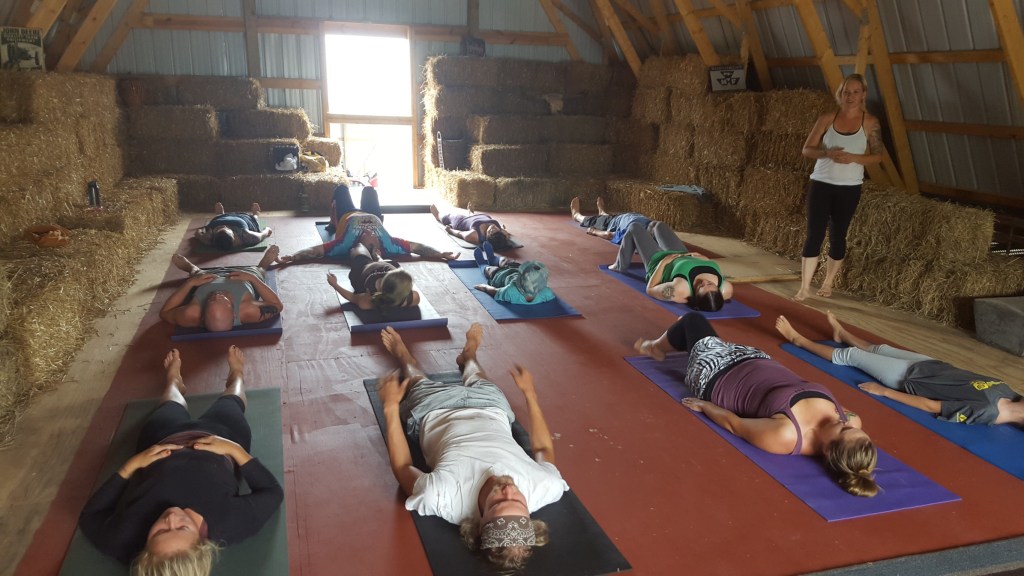
My friend and neighbor Tracy Hovde is a professional yoga instructor and part-time farmer with her partner, Mark Triebold. They run Lazy I Ranch, raising cattle on 80 acres just a few miles down the road from my farm. Mark bought the property 10 years ago and started raising Highland cattle six years ago. Tracy brings her yogic perspective to raising their cattle.
…
I spoke to Tracy in September 2016 about her thoughts on how farmers can keep their bodies and minds healthy and what it is like to raise cattle and practice yoga in the countryside:
What led you to practice yoga, and what does yoga mean to you?
Like most people, I started yoga for purely physical reasons. I started a regular yoga practice when I was a dancer. The physical demands of dancing were extreme, and I wasn’t taking good care of myself. I was burned out and was constantly injured.
I found that the Vinyasa classes offered at the gym I worked at as a massage therapist satisfied my need to move, and did so in a way that didn’t strain my body. Now yoga is less about the postures and more about the way I live, the way I view the world around me and my place in it.
When you teach a yoga class, what are your goals, and how do you work toward them?
My goal is always to bring balance. I never know what that means until my students walk into the room and I see how they are walking, their mood, what are they talking about, their energy level, etc. I also factor in things like season, weather and time of day. I use different breathing exercises (Pranayama), poses and specific sequencing of poses, as well as different styles of yoga to help shift their energy toward balance.
—
Read the full article at EcoFarmingDaily.com:
https://www.ecofarmingdaily.com/farmers-mindfulness-health/
By Andrew French. This article appeared in the April 2017 issue of Acres U.S.A. magazine. Andrew French is a livestock farmer and permaculture designer based in western Wisconsin working on developing a viable model of regenerative pig farming from farrow to finish using a whole systems design approach. He can be reached at fullboarfarm@gmail.com. Visit fullboarfarm.com for more information.
When science meets mindfulness (The Harvard Gazette)
In 2015, 16.1 million Americans reported experiencing major depression during the previous year, often struggling to function while grappling with crippling darkness and despair.
There’s an arsenal of treatments at hand, including talk therapy and antidepressant medications, but what’s depressing in itself is that they don’t work for every patient.
“Many people don’t respond to the frontline interventions,” said Benjamin Shapero, an instructor in psychiatry at Harvard Medical School (HMS) and a psychologist at Massachusetts General Hospital’s (MGH) Depression Clinical and Research Program. “Individual cognitive behavioral therapy is helpful for many people; antidepressant medications help many people. But it’s also the case that many people don’t benefit from them as well. There’s a great need for alternative approaches.”
Shapero is working with Gaëlle Desbordes, an instructor in radiology at HMS and a neuroscientist at MGH’s Martinos Center for Biomedical Imaging, to explore one alternative approach: mindfulness-based meditation.
In recent decades, public interest in mindfulness meditation has soared. Paralleling, and perhaps feeding, the growing popular acceptance has been rising scientific attention. The number of randomized controlled trials — the gold standard for clinical study — involving mindfulness has jumped from one in the period from 1995‒1997 to 11 from 2004‒2006, to a whopping 216 from 2013‒2015, according to a recent article summarizing scientific findings on the subject.
The full article is here:
https://news.harvard.edu/gazette/story/2018/04/harvard-researchers-study-how-mindfulness-may-change-the-brain-in-depressed-patients/
The One Quality You Must Instill In Your Child (Huffington Post)
By Amanda McCorquodale
Published (c) 2013 The Huffington Post, November 2013
Teachers and parents: What if we told you you were only 10 minutes away from having studious, focused, well-adjusted, compassionate, and happy children?
Some researchers say the secret is mindfulness, a daily meditative practice that emphasizes bringing one’s complete attention to the present moment.
Enter Mindful Kids Miami, a non-profit working to introduce mindfulness into Miami-Dade public schools, oncology wards, and centers that serve abused children and their families.
“Children and teens are experiencing much higher levels of stress today,” York-Zimmerman told The Huffington Post. “And stress impairs the ability to learn and effects executive function in the brain. Executive function correlates with working memory, emotional regulation, resilience, and socially appropriate behavior – all important functions in development and learning.”
Here are five ways a mindful child can benefit in the classroom and at home, according to York-Zimmerman:
-
- Mindfulness increases attention and focus that can result in higher academic achievement.
- Mindfulness reduces stress, allowing kids to learn more and perform better throughout the day.
- Mindfulness has been shown to improve kid’s impulse control, a benefit that can increase productive teaching time in the classroom.
- Mindfulness develops emotional regulation in turn teaching children to “respond” rather than “react.”
- Mindfulness builds empathy and compassion in children, cultivating greater tolerance of cultural, religious and sexual diversity; and reducing cruelty, bullying, and violence leading to safer and happier schools.
“It’s something teachers can do in the classroom and parents can do at night when putting a child to bed,” she said. “Even big kids like focusing on their breath with a lovable stuffed animal.”
Breathing Bear Practice:
Mindful Kids Miami has adorable, stuffed teddy bears wearing hoodies that have the MKM logo on the back and “BREATHE” on the front. These friendly bears help children to become aware of their breath, to relax, and to learn to breathe fully into their bellies.
Intention: To experience relaxation with your Breathing Bear.
Instructions:
-
- Ring the mindfulness chimes 3 times.
- Ask the children to lie down on their backs and put their Breathing Bear on their belly.
- Invite them to close their eyes if they are comfortable doing so. If not, almost close them. And see if they can feel their friendly bear resting on their belly.
- Now encourage the children to feel their breath flowing into and out from their nose.
- To feel their chest rising with each in-breath and falling with each out-breath.
- To notice if they can feel their belly moving up and down gently with each breath… feeling the belly expand and deflate slightly like a balloon with each breath.
- Now invite the children to focus on feeling their Breathing Bear riding on their belly.
- Seeing if they can take their Breathing Bear for a relaxing belly ride up and down.
- Invite them to notice if their Breathing Bear helps them to feel their breath.
- Continuing on in your own words if you like.
- Now invite the children to listen to the chimes with their mindful ears without moving until they can’t hear the chimes anymore.
- Ring the mindfulness chimes 3 times.

Buddha Lessons (Newsweek)
by Claudia Kalb, Sept. 26, 2004
For decades, Dalia Isicoff has suffered the agony of rheumatoid arthritis–joint pain, spinal fusion, multiple hip surgeries. Painkillers dull the aches, but it wasn’t until she took a course at the University of Maryland’s Center for Integrative Medicine that Isicoff discovered a powerful weapon inside her own body: her mind. Using a meditative practice called Mindfulness-Based Stress Reduction, or MBSR, Isicoff learned to acknowledge her pain, rather than fight it. Her negative and debilitating thought patterns–“This is getting worse,” “I’m going to end up in a wheelchair”–began to dissipate, and she was able to cut back on her medication. The pain hasn’t gone away, but “I view it is an ally now,” she says. “Mindfulness is transformational.” Continue reading “Buddha Lessons (Newsweek)”